Humectants – What Are They And How Do They Benefit Your Skin?
Humectants are everywhere. They are used in your creams, lotions, serums, and conditioners. Only why are these agents important? What exercise they do? In this commodity, we will have you through the fundamentals of humectants and how they piece of work and benefit your peel. Go on reading.
What Is A Humectant?
Shutterstock
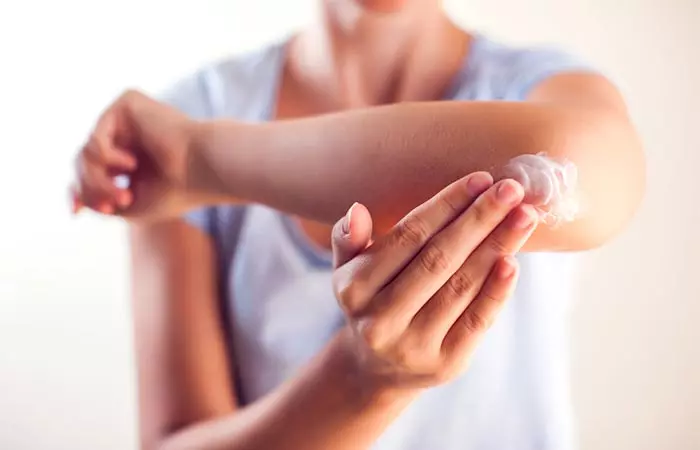
A humectant is a hydrating agent found in creams, lotions, serums, conditioners, and several other pare intendance and hair care products. Humectants tin attract and demark with the h2o molecules, helping your skin and hair preserve wet and stay hydrated.
Humectants are of several types and non all function akin (we take discussed this later in the article). The way a humectant behaves often depends on the other ingredients of the product or the formula of the product. Accordingly, humectants can add to the overall benefit offered by the product. In the post-obit section, we will discuss how they function.
How Do Humectants Work?
Shutterstock
Recollect of a magnet and how it attracts atomic number 26. Similarly, humectants attract water. They draw water mainly from two sources (i):
- From the dermis into your epidermis (from the inner layer to the top layer of your peel)
- From the environment (while humid)
Humectants also assist your hair draw wet and retain it. Nevertheless, not all humectants piece of work for both skin and hair. That's the reason yous will not see the same humectants used in hair intendance and skin intendance products.
Humectants are keen for keeping your skin soft, supple, and hydrated. Let'due south take a look at the types of humectants that are available – those that we commonly meet in products.
What Are Different The Types Of Humectants?
Shutterstock
Humectants tin be natural as well as synthetic. Skin intendance and hair care products may contain either of them. Virtually manufacturers adopt synthetic humectants over natural humectants equally the former are cheaper. Though synthetic humectants perform the bones functions of a humectant and retain h2o, unlike natural humectants, they do not nourish your skin.
Some of the common natural humectants include:
1. Aloe Vera
This is one of the almost constructive naturally hydrating ingredients available. Studies accept found information technology to be effective in peel hydration, possibly due to its humectant-similar mechanism (2).
2. Honey
Dearest is a natural ingredient that has multiple benefits. It is an fantabulous humectant, emollient, and hair conditioner. It is loaded with useful amino acids, minerals, enzymes, and vitamins that keep your skin salubrious and smooth. Dear also helps soothe dissimilar skin weather (3).
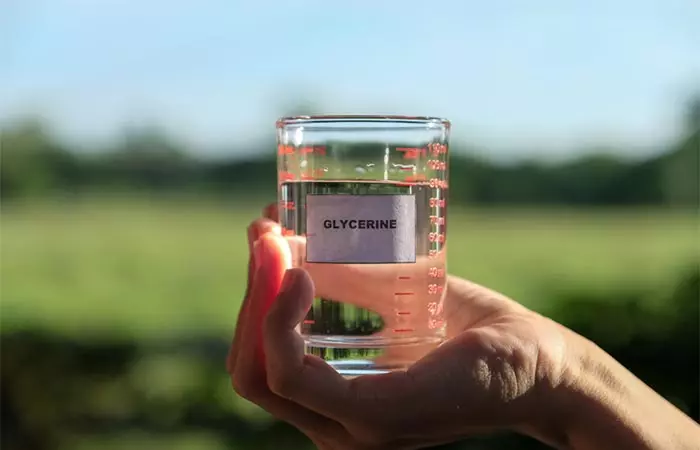
3. Glycerin
This one substance has both natural and synthetic equivalents. Synthetic or chemically derived glycerin is booze (Glycerol) that works as a humectant. Natural glycerin is derived from plant-based oils. Information technology is an excellent humectant. A study showed that it could increase the hydration levels of the skin and keep it soft (four).
4. Tremella Fuciformis Extracts
These are extracts from Tremella mushrooms and are a popular ingredient in K-beauty products. Though the mushrooms are used equally a culinary delight, their extracts are believed to exist extremely hydrating.
5. Alpha Hydroxy Acids (AHAs)
These are naturally derived from plants and are mostly used in anti-aging formulations. Some mutual AHAs include glycolic acrid, malic acrid, lactic acid, and mandelic acid. AHAs exfoliate your pare, clearing the dead skin cells, then the moisturizers can seep deeper into your skin layers.
Some of the common synthetic humectants include:
1. Hyaluronic Acid (HA)
Though hyaluronic acrid occurs naturally in your skin cells, the HA in peel care products is adult chemically. It is an fantabulous humectant that keeps the pare hydrated by retaining the moisture levels (5).
two. Urea
When used in lower concentrations (10%), urea is an excellent humectant. A report has shown that it can prevent transepidermal water loss (TEWL) and help your skin retain water and proceed it hydrated (1). All the same, urea may too crusade skin irritation, redness, itching, and a burning sensation.
iii. Polyethylene Glycols (PEGs)
PEG 400 and PEG 600 are the mutual humectants (6). PEGs are petroleum-based compounds that work by pulling moisture from the deeper layers of the skin to the topmost layers. Nonetheless, these might cause allergic reactions and dermatitis (7).
iv. Sodium PCA
This substance works equally a humectant and is mostly used in shampoos, conditioners, creams, lotions, foundations, and lipsticks. Unremarkably, it is used in concentrations ranging from 0.2% to 4%.
Humectants are not the only moisturizing agents that we run into in our products. At that place are some emollients and occlusives as well. Some humectants may non work well alone but give amend results when paired with these emollients and occlusives. Although these might have similar properties, they are dissimilar from each other. Let's find out how.
How Do Humectants Differ From Emollients And Occlusives?
Shutterstock
Humectants, emollients, and occlusives are different types of moisturizers. These are frequently used lonely or in combination in products for achieving optimal results. Although these three vest to the aforementioned category, they take their differences.
Form Of Moisturizers | Humectants | Emollients | Occlusives |
How They Work | Describe water either from the dermis (to a certain extent) or from the humid air. | Fill the rough expanse on the skin to make information technology smooth. Don't affect the water content of the skin. | They create a barrier to trap water on the skin (either supplied to the peel by a moisturizer or when soaked in water). |
How They Feel | Feel sticky (when used alone). | Experience nice on the pare. | Experience heavy on the skin. |
Side Furnishings | A few might cause irritation (urea, lactic acid). | Rarely cause irritation. | Clog peel pores and may cause folliculitis and contact dermatitis. |
Examples | Hyaluronic acid, urea, glycerol/ glycerin, and AHAs (lactic acid). | Squalene, cholesterol, ceramides, and fatty acids (oleic, linoleic, lauric acids). | Beeswax, mineral oils, silicones, zinc oxide, lanolin, dimethicone, and petroleum jelly. |
At present yous know how humectants differ from the other types of moisturizers. Allow's sympathise how you can use humectants to moisturize your skin properly.
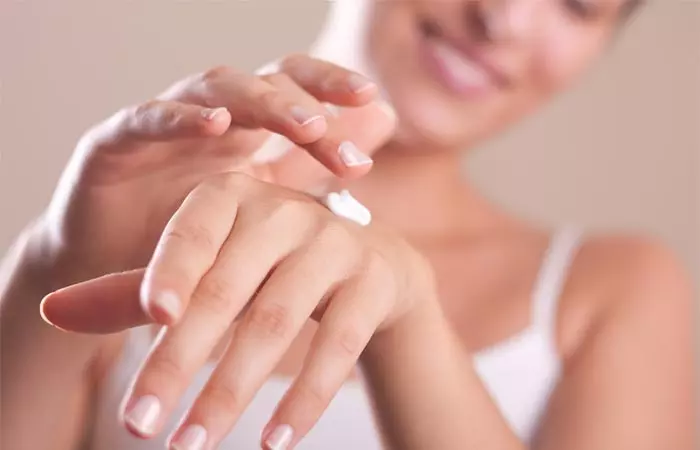
How To Use Humectants To Moisturize Your Skin Properly
Shutterstock
Whether yous are using products with humectants or any other type of moisturizing agent, there is a certain way to apply them. The National Eczema Association has some guidelines regarding proper moisturizing techniques (8):
- Apply the moisturizer right after bathing and while the skin is yet damp. If you are using any skin medication, employ it first, followed by the moisturizer.
- Before applying, take some moisturizer in your palm and rub it.
- Apply it in a downward management.
- Avoid rubbing information technology in an up-and-down motion or in circles.
- Always leave a picture show of moisturizer on the skin and permit your skin blot it.
Now that you know everything about humectants, here are some product suggestions for you.
Products With Humectants That You May Check Out
The type of humectant you pick depends on the needs of your pare. For case, if you take oily and acne-prone skin, your skin will need something with salicylic acid or AHAs that tin can articulate the expressionless skin cells. Too, you can get products with both humectants and occlusives if your skin needs intense hydration.
Each skin type has different preferences. When choosing a production with a humectant, try out different products until yous discover the i that makes your skin feel comfortable. Many adopt to mix and match products, while some like it the way they are. Earlier choosing whatsoever product, read the ingredients listing carefully.
Sources
Articles on StyleCraze are backed past verified information from peer-reviewed and academic research papers, reputed organizations, enquiry institutions, and medical associations to ensure accuracy and relevance. Cheque out our editorial policy for further details.
- Moisturizers: The slippery road, Indian Journal of Dermatology, United states National Library of Medicine, National Institutes of Health.
https://www.ncbi.nlm.nih.gov/pmc/articles/PMC4885180/ - Moisturizing result of corrective formulations containing Aloe vera extract in different concentrations assessed by pare bioengineering techniques, Skin Research and Technology, US National Library of Medicine, National Institutes of Health.
https://www.ncbi.nlm.nih.gov/pubmed/17026654 - Honey in dermatology and peel care: a review, Periodical of Corrective Dermatology, United states National Library of Medicine, National Institutes of Wellness.
https://www.ncbi.nlm.nih.gov/pubmed/24305429 - Glycerol and the peel: holistic approach to its origin and functions, The British Journal of Dermatology, Us National Library of Medicine, National Institutes of Wellness.
https://www.ncbi.nlm.nih.gov/pubmed/18510666 - Hyaluronic acid: A central molecule in skin aging, DermatoEndocrinology, U.s. National Library of Medicine, National Institutes of Wellness.
https://www.ncbi.nlm.nih.gov/pmc/manufactures/PMC3583886/ - Influence of some humectants on the physical characteristics of solidified sodium stearate-based sticks, International Journal of Cosmetic Science, The states National Library of Medicine, National Institutes of Health.
https://www.ncbi.nlm.nih.gov/pubmed/19469997 - Skin reactions to propylene glycol, Contact Dermatitis, US National Library of Medicine, National Institutes of Health.
https://www.ncbi.nlm.nih.gov/pubmed/233872 - Proper Moisturizing Techniques, National Eczema Foundation.
https://nationaleczema.org/proper-moisturizing-techniques/
Was this article helpful?
The following two tabs change content below.
- Author

Ramona is an associate editor at StyleCraze. Prior to that, she authored over 200 articles on skin and hair intendance.... more
Source: https://www.stylecraze.com/articles/what-is-a-humectant-in-skincare/
0 Response to "Humectants – What Are They And How Do They Benefit Your Skin?"
Postar um comentário